This post summarize things I've learned / reviewed over the 1st week of my Quantum Computing Ultralearning challenge. There are two parts: maths and articles (the current one).
Articles #
Simple Rules for a Complex Quantum World: An exciting new fundamental discipline of research combines information science and quantum mechanics - Michael A. Nielsen. Quotes:
The central goal of quantum information science is to develop general principles, like the laws of entanglement, that will enable us to understand complexity in quantum systems.
In 2001 Benjamin W.Schumacher proposed that the essential elements of information science, both classical and quantum, can be summarized as a three-step procedure:
- Identify a physical resource.
- Identify an information-processing task that can be performed using the physical resource of step 1.
- Identify a criterion for successful completion of the task of step 2
What is the minimum number of bits needed to store the information produced by some source?
How much classical information can we store in a qubit?
- Incorrect answer: infinite because you can encode but can never retrieve them.
- Correct answer: only one bit of information would have been extracted. Whichever measurement you choose erases all the information in the qubit except for the single bit that the measurement uncovers. This was proved in 1973 by Alexander S. Holevo following a 1964 conjecture by J. P. Gordonof.
- Holevo chi (χ), that has since been used to simplify the analysis of more complex phenomena.
Entanglement:
- It is easy to be misled into thinking that one could use entanglement to send signals faster than the speed of light, in violation of Einstein’s special relativity, but the probabilistic nature of quantum mechanics stymies such efforts.
superdense coding: entanglement canassist the sending of classical information from one location to another, in which two bits are transferred on a particle that seems to have room to carry only one.
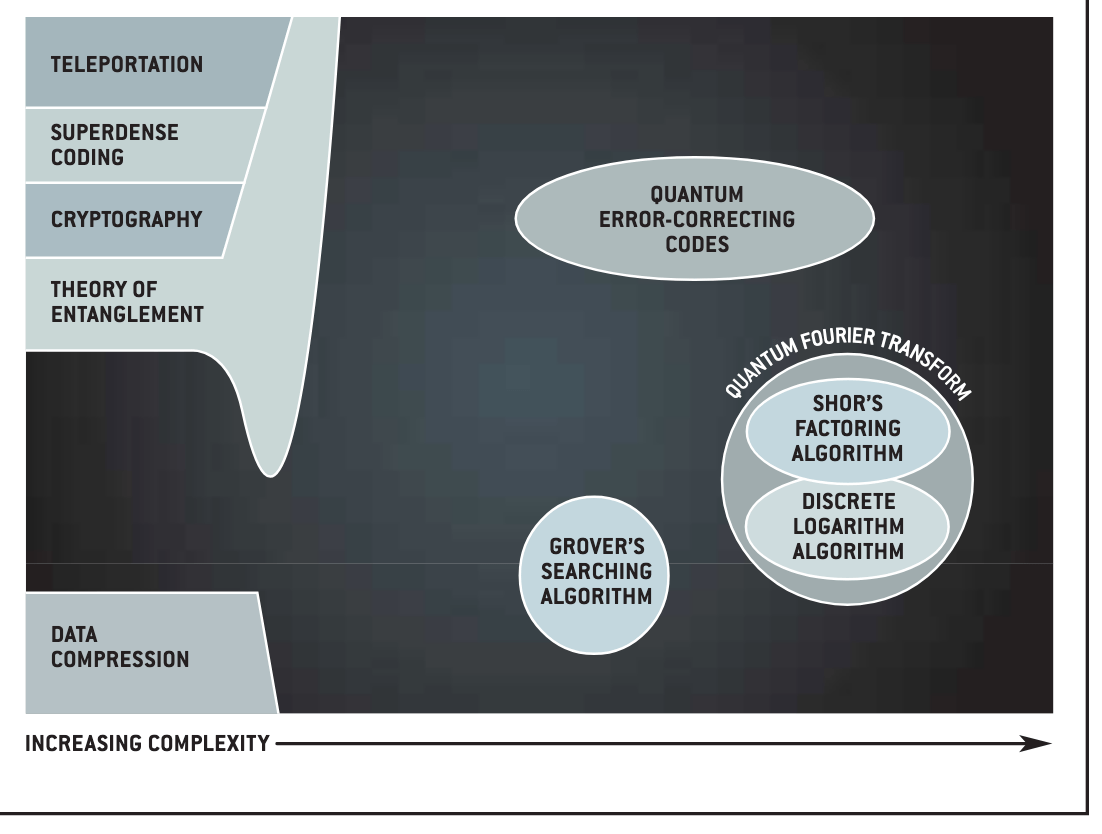
Shor’s algorithm:
- At first glance, it looks like merely a clever programming trick with little fundamental significance. That appearance is deceptive; researchers have shown that Shor’s algorithm can be interpreted as an instance of a procedure for determining the energy levels of a quantum system,a process that is more obviously fundamental.
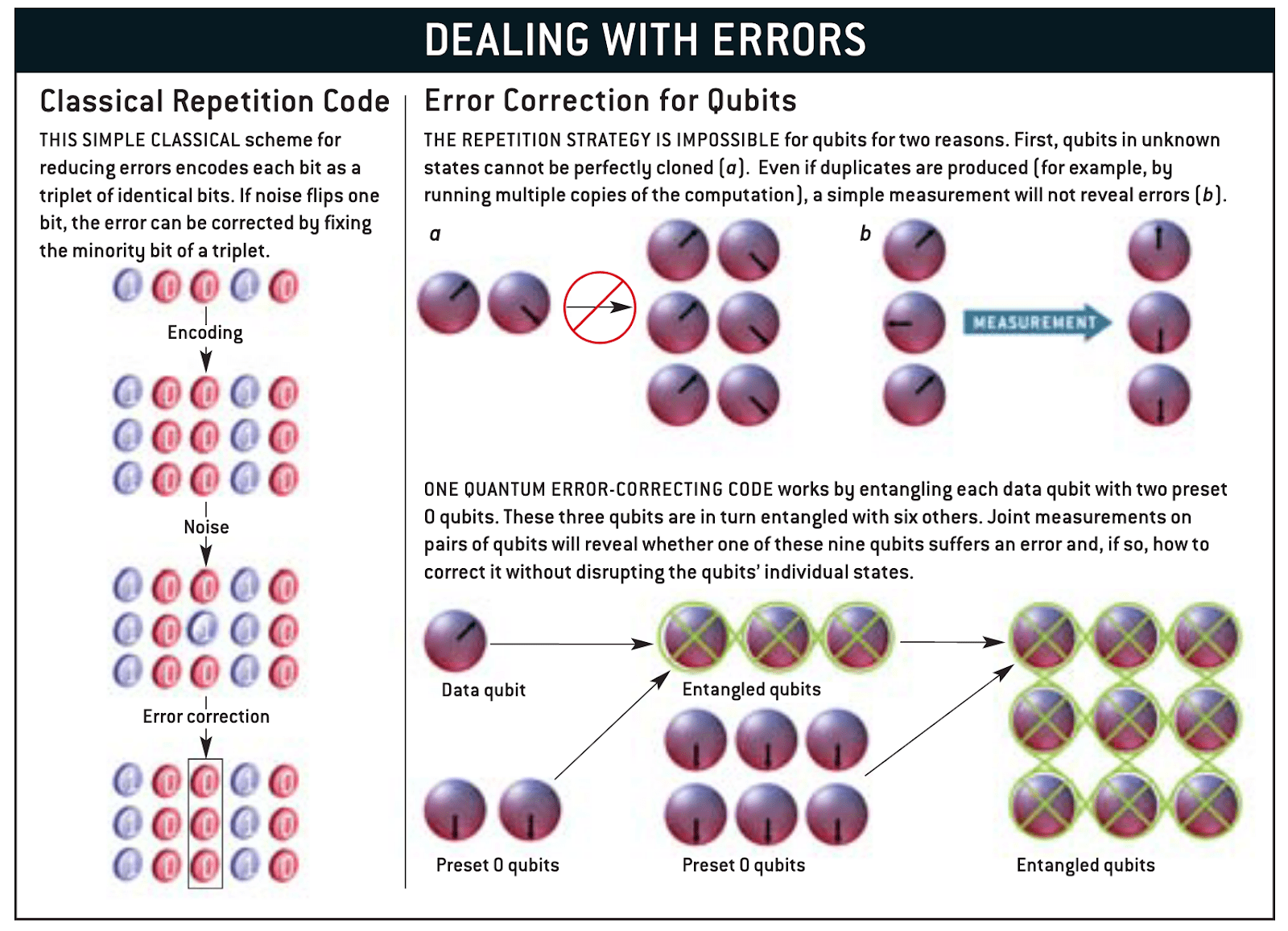
Quantum error correction: quantum mechanics forbids us from learning with certainty the unknown state of a quantum object — the obstacle, again, of trying to extract more than one bit from a qubit. The simple classical triplet code therefore fails because:
- One cannot examine each copy of a qubit and see that one copy must be discarded without ruining each and every copy in the process
- Making the copies in the first place is nontrivial: quantum mechanics forbids taking an unknown qubit and reliably making a duplicate, a result known as the no-cloning theorem.
- Quantum error-correcting codes are a triumph of science. Something that brilliant people thought could not be done — protecting quantum states against the effects of noise — was accomplished using a combination of concepts from informa-tion science and basic quantum mechanics.
In what sense is quantum computing a science? - Michael Nielsen Quotes:
"In natural science, Nature has given us a world and we’re just to discover its laws. In computers, we can stuff laws into it and create a world." – Alan Kay
Invention is accurate in the sense that it’s a creation of the human mind. But it’s a discovery in the sense that it seems as though it’s a pre-existing property of the universe. Topological quantum computers, homoiconicity, stealth, arabic numerals, even the idea of layers: all have a depth and unitary quality that makes it hard to see them entirely as ad hoc inventions. It’s true that many details are ad hoc: the specifics of arabic numerals are obviously not universal! But if we meet aliens I won’t be surprised to find that they’ve discovered (and perhaps superseded) many of the same ideas used in the arabic numerals. Indeed, I won’t be surprised if they’ve also discovered homoiconicity, topological quantum computing, and perhaps even something like our conceptions of stealth and the idea of layers.
Physicists often work from the bottom up, understanding simple systems, or putting things together in “natural” ways (e.g., by cooling materials down or heating them up). Routine design work is somewhat similar, taking extant elements and combining them in standard ways. But the deepest types of imaginative design are very different, creating fundamentally new types of objects and new types of behaviour. I won’t try to enumerate the heuristics behind that kind of work here (though see my earlier essay). But it’s a very different kind of work than traditional physics.
This point of view contrasts with the conventional point of view that says quantum computing will mostly be about finding fast new algorithms. Certainly, it will in part be about finding new algorithms. But I don’t think it’s likely to just or even primarily be about algorithms, any more than classical computing has been. Indeed, I believe the design of new prototocols and new interfaces – the invention of new types of object and behaviour – has been much more important in classical computing. And so, perhaps, it may ultimately be for quantum computing.
Quantum Computing for Everyone - Michael Nielsen. Quotes:
It’s NOT that quantum computers are like regular computers, but smaller and faster. Rather, quantum computers work according to principles entirely different than conventional computers, and using those principles can solve problems whose solution will never be feasible on a conventional computer.
Quantum computers CANNOT be explained in simple concrete terms; if they could be, quantum computers could be directly simulated on conventional computers, and quantum computing would offer no advantage over such computers. In fact, what is truly interesting about quantum computers is understanding the nature of this gap between our ability to give a simple concrete explanation and what’s really going on.
Quantum parallelism is an appealing story, but it’s misleading. The problem comes in the second part of the story: picking out the correct solution. Most of the time this turns out to be impossible. This isn’t just my opinion, in some cases you can mathematically prove it’s impossible.
Further readings #
Since you've made it this far, sharing this article on your favorite social media network would be highly appreciated!
For feedback, ping me on Twitter.
All the information on this blog are my own opinions and do NOT represent the views or opinions of any of my past or current employers.
Published